



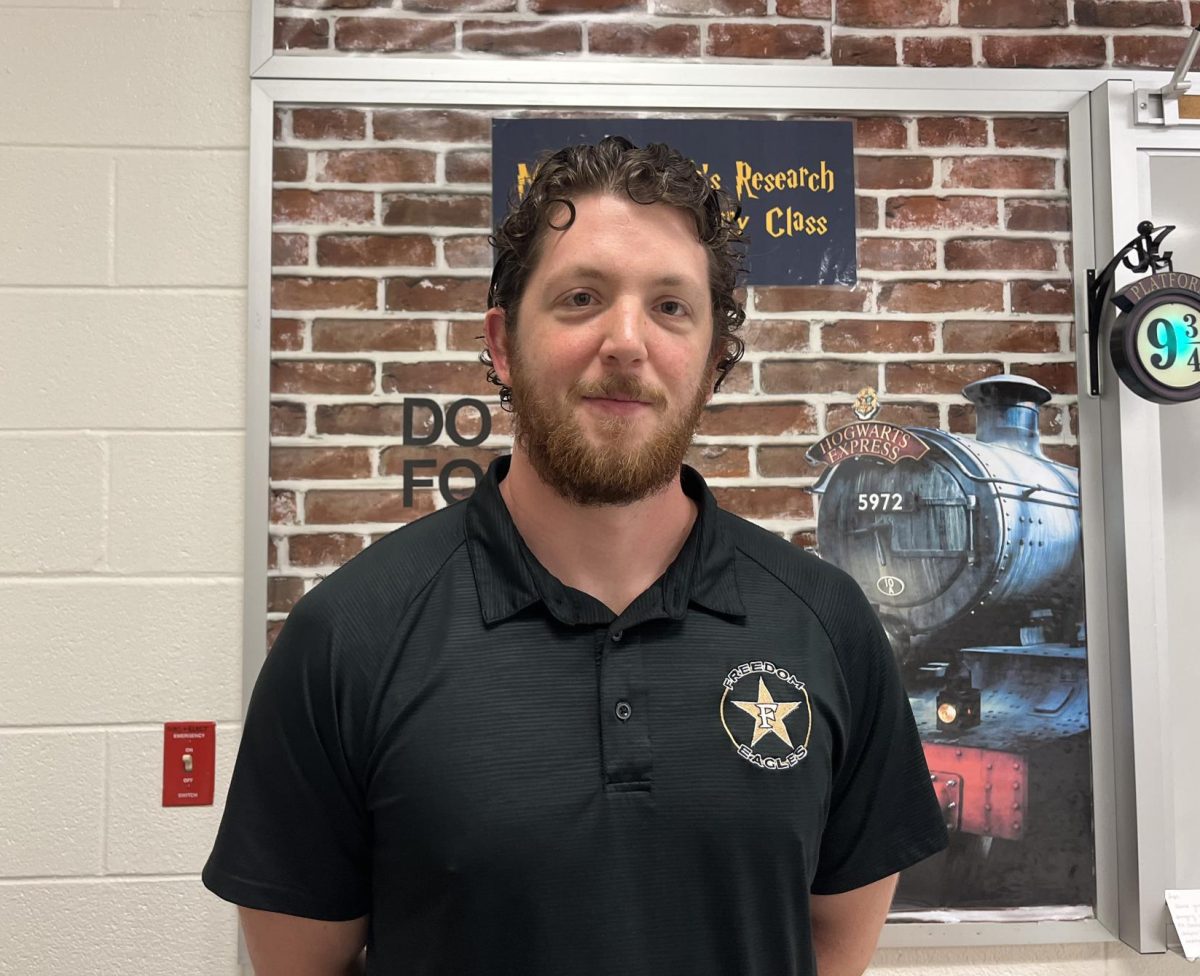














John Chapin didn’t always see himself as a teacher. In fact, before stepping into the classroom, he was a math major, a programmer and had even started several successful companies.
Chapin got his MBA and after that, it was all about business. He started a couple of businesses, and they were fairly successful with one going public. Afterwards, he had a real estate investment company as well.
“I probably only had to work about half time, and my wife says, ‘Well, why don’t you volunteer at Tuscarora High School and they had this opportunity where you could volunteer in a computer science classroom,’ so I did,” Chapin said. “And, every day, I would come home and go, it’s so awesome. The kids are awesome. I love teaching. This is really cool.”
The volunteering experience made a big difference. The regular teacher barely lectured so Chapin felt his presence matters.
“I felt like it was making a difference. So then they had this program where you could be a career switcher.”
Chapin entered a career switcher program, passed his practice exams, and began teaching about 11 years ago. Since then, he has taught math, computer science and started the computer science pathway at the Academies of Loudoun. He earned his PhD in curriculum and instruction and even began teaching college students as an adjunct professor at George Mason.
Chapin envisions a future for computer science, where it can be integrated into everyday learning for students.
“I’m also working on an AI curriculum for general regular high school students with code VA,” Chapin said. “It’s mainly about how to integrate so that students can use the computing, programming tool to do bio biology, or economics, or health informatics that’s where the future is.”
Still, the switch from business to teaching had its fair share of challenges. Chapin recalled his first year balancing teaching full-time with selling off his business properties and even being audited by the IRS at the same time.
“I was in the middle of negotiating a sale for my last property, and then I’m also trying to come up with a curriculum for and teach pre-calculus and computer math,” Chapin said. “It’s wonderful on one hand, because I like learning new stuff, but it’s horrible on the other hand, because I’m constantly having to redo my material, especially with machine learning.”
Even now, Chapin says that the hardest part of teaching computer science is keeping up with the ever-evolving field. Chapin also gives advice for students or anyone considering a career shift.
“Right now, it is all about your superpower, learning a specific domain and then learning how to use the computing tool to upskill you,” Chapin said. “You don’t have to be the best programmer in the room. Just learn to do it pretty well, and you’re gonna get a job.”