















Editor’s note: Students quoted in this article have requested anonymity and therefore have not been identified.
Gambling among high school students has become more visible in recent years, appearing in conversations around sports, social groups and informal games. Students describe it as part of peer interaction as well as entertainment, with involvement ranging from casual participation to more structured betting habits.
Many students say their introduction to gambling comes through friends and social groups, where sports betting and poker are often discussed as part of normal conversation.
“I first got into sports betting through some of my friends who also did it,” said FHS student #1. “At first it was just something we would talk about during games and in group chats. People would say who they thought was going to win and what bets they were making. It started to feel like a normal part of the conversation and intriguing, so I ended up trying it too.”
Gambling is said to be particularly appealing to adolescents due to the nature of the game as well as the possibility of fast money.
“Teenagers are often drawn to gambling because it combines excitement, risk-taking, and the possibility of quick rewards,” said AP Psychology teacher Justin Stewart-Fritz. “From a psychological standpoint, their brains are still developing, especially the prefrontal cortex, which is responsible for impulse control and decision-making. That makes them more sensitive to immediate rewards than long-term consequences.”
Some students describe specific event gambling, such as sports betting, as a way to make the event more engaging, changing how they watch and follow outcomes.
“Sports betting specifically, I think it gives an excuse to watch the games that you bet on,” said FHS student #2. “You end up planning around those games and paying attention in a different way because you feel more involved in the outcome. You also get much more attentive to what happens in the games if you have a bet on it, and you find yourself following every play more closely than you normally would.”
For students who participate with real money, gambling involves varying levels of financial risk and different personal approaches to managing spending.
“I always kept my bets consistent with how much I had in my bankroll, so I would set aside a certain amount of money specifically for betting and only use a small percentage per bet,” said FHS student #2. “The rule of thumb is to use about 1% per bet, so even when my bankroll grew, I would only increase the amount slightly and try to stay within that limit.”
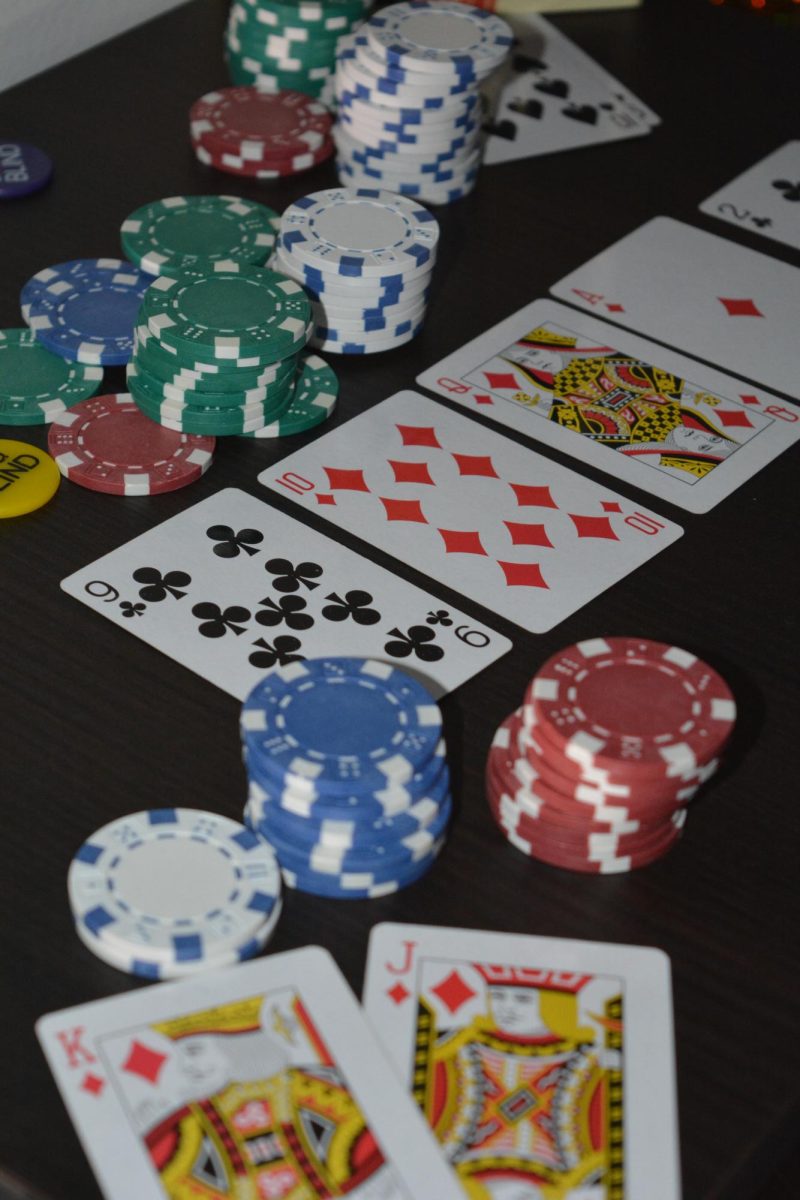
Others describe gambling, especially poker, as a strategy-based activity that involves decision-making, probability and performing under pressure.
“I enjoy the mental part of betting,” said FHS Student #1. “Because poker is an exploitative type of gambling, it tests my ability to think in stressful situations and challenges me to make difficult decisions. If the money was not real, there would be nothing to lose and you would not have to think about what you do.”
Some students also note that games can still be enjoyable without money involved, emphasizing their competitive and social nature.
“When money is involved in any type of game or bet, it immediately deters me to play because it feels like there is actually something at stake,” said senior Riva Shah. “However, when playing without money, especially in poker, I get to simply enjoy experimenting with different strategies while also learning how the people around me play, all without having to risk anything. You can still assign value to chips in a symbolic way, so there is always a competitive aspect to the game.”
Several students say gambling is closely tied to social interaction. They describe it as something that frequently comes up in conversation and group settings, sometimes influencing participation simply through exposure and inclusion.
“Gambling is something that just naturally comes up when we’re talking about sports or what people are doing that night,” said FHS student #1. “A lot of the time it is part of the conversation already, so you just end up talking about what games people are betting on or someone’s hand from the day before.”
Students also point to gambling becoming more common in high school environments. They describe it as something increasingly present in everyday peer conversations, making it feel more normalized than in the past.
“Underage gambling has become extremely common in my opinion, and it has started to feel normal in high school because so many people are doing it in different ways,” said senior Nikith Vatsavayi. “It is not something that stands out anymore the way it probably would have before, since you see or hear about it pretty often.”
Despite its growing visibility, underage gambling remains illegal in Virginia and is not supported by Freedom High School. School policies prohibit activities involving betting or the exchange of money on campus, reflecting broader state laws that restrict gambling to individuals 21 and older. Administrators emphasize that while students may view gambling as entertainment, it carries legal and financial risks that can have serious consequences.
“I wasn’t aware that this was an issue in Freedom, but if it does happen here then I think awareness definitely should be brought to this subject,” said Darnell Barbour, assistant principal. “Gambling is illegal if you were under the age of 18, so I would say that any student under the age of 18, I would not approve of gambling.”
As gambling becomes more visible in high school environments and more integrated into everyday social interaction, experts suggest its appeal is shaped less by the activity itself and more by developmental and social factors influencing teenage decision-making. While students often describe it as entertainment or a way to engage more deeply with sports and games, it is noted that adolescence is a period marked by heightened sensitivity to reward and peer influence.
“Adolescents tend to have a more active reward system compared to their impulse-control system,” said Stewart-Fritz. “This imbalance can lead to riskier choices, especially in situations that involve money, competition, or social pressure. Gambling directly activates the brain’s dopamine system, reinforcing the behavior even when losses occur.”