






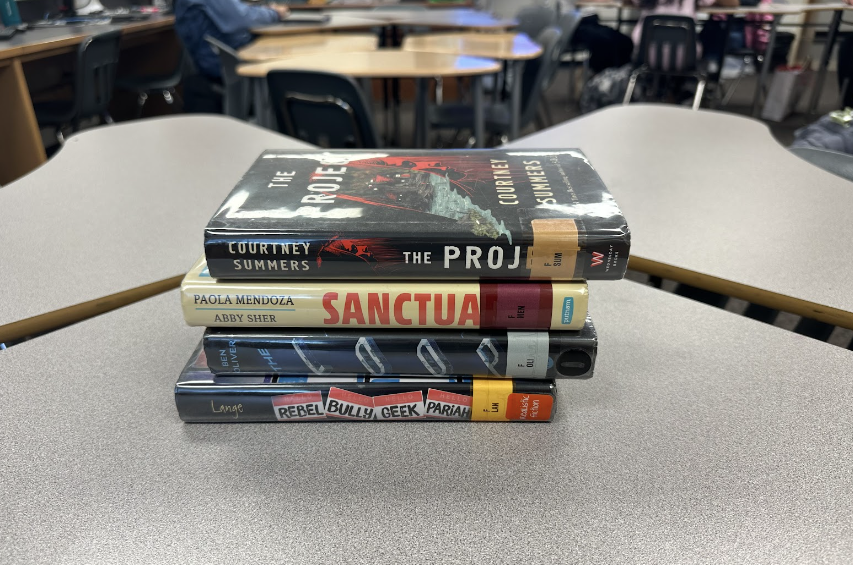





Welcome back to Well Read Book Review. For the month of May, we will be featuring two different awareness months! May is both Foster Care Awareness Month and Mental Health Awareness Month, so here are five books for May.
“Orbiting Jupiter” – Gary D. Schmidt
A boy named Jack has a new foster brother. He knows three things about Joseph, he almost killed a teacher, he was sent to juvie, and he has a daughter named Jupiter. Joseph doesn’t seem like a bad kid. He’s quiet, and doesn’t bother Jack much, but over time, he learns more and more about his foster brother. Jack realizes how much Joseph’s daughter really means to him, and how he needs to help Joseph find her.
4.23 Average Stars on Goodreads. When Joseph is placed with Jack’s family, they get a warning, but when Joseph finally arrives, he’s quiet, but quickly falls into a routine. He acts like an older brother to Jack, a bit rude at times, but that’s just how siblings are. This book is one of my favorite books I’ve read for Well Read. It’s a short and easy book to read, and totally worth the read. Joseph is set on finding his daughter, especially after losing the girl he loved. Joseph was so confident and strong, even after the things he’s gone through. He couldn’t see his daughter, his dad was unsafe, he was in a new place, and got into trouble, but despite everything he was strong. There’s not much else I can say without spoilers, but this is an amazing book. Five stars.
Tags – Young Adult, Fiction, Family, Coming of Age, Friendship, Realistic Fiction
Can be found in the FHS library
“What I Carry” – Jennifer Longo
Pack light. That’s what Muir has learned in her many many years in foster care. That means only having what you can fit in a suitcase. Being in foster care means that Muir has lived in many houses. She refuses to make friends, or get attached to her foster families because she knows she’ll be leaving sooner or later. That’s her rule until she meets Francine. And Kira. And Sean. That’s when everything changes.
4.21 Average Stars on Goodreads. The book was overall pretty good. It had cool characters, and a pretty good ark, but didn’t have too much drama, which can be expected in a realistic fiction book, I just like more dramatic books. Most of the story was focused on Muir’s internal conflict, where she can’t decide whether or not to let herself get attached, and while those types of internal conflicts are repetitive, it got a little boring at a certain point. In the end, I’m glad that Muriel ended up figuring out what’s best for her future. It’s satisfying to see her get a happy ending. 3.5 stars.
Tags – Young Adult, Contemporary, Fostering, Family, Coming of Age, Realistic Fiction
Can be found in the FHS library
“Primer” – Jennifer Muro, Thomas Krajewski, Gretel Lusky
Ashley is an upbeat kid, but she’s got a surprising past. Her father’s in jail, so Ashley has bounced around from house to house. Ashley isn’t a bad kid, but she tends to find herself in odd situations. Things start to look up for Ashley when she’s with a new and loving family, and makes a friend, but things get complicated real fast. Ashley finds a case of body paints in her foster mom’s closet, and being nosy, Ashley paints them on, only to realize they give her amazing abilities. While Ashley believes this is the greatest thing to happen to her, she’s soon sought out by the government, who desperately wants their paints back. Now Ashley has to make a lot of hard choices as she tries to figure out how to protect her new parents and learn what it really means to have a family.
4.04 Average Stars on Goodreads – I’ve read this book twice, and I honestly love it. It’s an amazing graphic novel with a really cool design, and bright colors, making things pop off the page. Throughout the story, Ashley aka Primer, uses a science experiment to give herself powers. In the book, Ashley is very happy in her newest foster home, but at the beginning there’s a misunderstanding that her foster mother, Yuka, thinks she’s making a mistake. The situation falls under the “miscommunication trope,” and while I normally hate it, this story does it decently. While Ashley is very happy with her foster parents, in the book we also get a look into Ashley’s bio dad, who is in prison. We see short flashbacks, and it’s really cool to see. This also sets up for the second book in the series as well, but I will mention that I didn’t find the second book all that enjoyable. This graphic novel was a great break from the past couple of darker books that I’ve read recently. Overall, 4 stars.
Tags – Graphic Novels, Superheros, Fantasy, Middle Grade, Science Fiction
Cannot be found in the FHS library
“How to Make Friends with the Dark” – Kathleen Glasgow
It could be the brightest summer day, but it is dark outside. The dark is in your house, in your room, and it’s dark in your heart. That’s how it’s always felt to Tiger. For forever, it’s been Tiger and her mom against the world. Then, on a day like any other, Tiger’s mom dies. “Her brain exploded” is what Tiger tells people, whether they ask or not. Tiger is alone. Tiger learns how to make friends with the dark.
4.07 Average Stars on Goodreads – There are two quotes that are in the last few pages of the book that hit me hard. While they may not seem important before reading the book, after everything, they hurt, and even before reading, I bet it’d hurt if being read by the right audience. The first quote reads, “Parents shouldn’t die before their kids get old, but they do. Parents shouldn’t beat their kids, and break their backs, or lock them in dog cages, or let them live in cardboard boxes by the 7-Eleven, but they do. I don’t know how to live now, knowing what I do, but I have to keep going” (Glasgow 408). The second quote says, “I feel like I was one girl before my mother died, and another girl after, and now, at the end of this story, still another girl, crawling out of the jar, but keeping her wings close. There’s so much I wish I didn’t have to know about living” (Glasgow 409). For Tiger, the entire book is hard for her. This book does so well showing the unfiltered thoughts of losing someone. The thoughts wondering about where they are, the doubt that they’re gone, even the thoughts about joining them. “How to Make Friends with the Dark” is a book about dealing with grief, and it’s not like others you may read that teach you you’ll learn to move on, instead it tells you the truth. You’ll always be grieving, but you’ll learn to live with grief, not leave it behind. “‘The way I like to think about it is, when my dad was sick? That was my Sick Life. I had eight years of Sick Life…Now that he’s gone, I have grief life, which is horrible in it’s own way…But Grief Life? That’s forever. And it’s going to really suck. It does suck. That’s the Big Suck I was telling you about.'” (Glasgow 290). That quote was from a character speaking about the death of her dad, and how she thought about it. I think this quote shows how the entire book thinks about grief. Grief is forever, and it sucks. This book does an amazing job showing how grief shows itself, and the realities of what could happen in the world, especially to kids. Not everything is sunshine and rainbows for kids, some kids don’t get happy childhoods and this book shines a light on that reality. Five stars.
Tags – Young Adult, Contemporary, Mental Health, Realistic Fiction, Grief, Coming of Age
Can be found in the FHS library
“All the Bright Places” – Jennifer Niven
Theodore Finch is fascinated by death. Finch often thinks about how he may die one day. Violet Markey lives for the future. She counts down the days until her graduation, the days until she can leave the Indiana town. The days until she can leave her sisters death behind. Finch and Violet meet on the ledge of a bell tower at school, and it’s not quite clear who saves who at the time. It’s only when he’s with Violet that Finch can be himself. As a loud, funny, and not so weird guy. It’s only with Finch that Violet feels she can stop counting days, and actually live them. As Violet’s world grows, Finch’s only seems to shrink.
4.11 Average Stars on Goodreads – I’m going to say this right now, before I even get into this book, I did not finish this book. I stopped reading about 130 pages in. I did not like this book. I was told that it was a great book and that it’d make me cry and yada yada yada, but I genuinely couldn’t get into it. From what I read, the book did not make the characters feel like real people, you never forget that these characters aren’t real. Finch was creepy! He often sexualized Violet, offering to make-out with her during their second meeting, and mainly looked at her for her body. He seemed like a stalker. Within the first 100 pages, he had done research on Violet, made a social media account just to talk to her, researched her sister and her sisters death and went to where Violet and her sister had gotten into a car crash, he even went far enough to steal the license plate from their destroyed car. Violet, while not as bad of a character as Finch, didn’t seem all that realistic either, she was very upset about her sister’s death, and most of the time is not angry, but overall pretty depressed, and there’s one point where it feels like Jennifer Niven managed to mischaracterize her own character! Violet, after getting an email saying that her and her sister’s blog domain is expiring gets upset, and after feeling sad, she deletes the email and Niven wrote, “And then I empty my trash so the email is as dead and gone as Eleanor” (Niven 66). This feels wildly out of character for Violet, and I just think it’s overall very weird for someone grieving to say something like that. As well as unrealistic actions and sexualizing characters, I think this book is a terrible representation of mental health issues. This book completely romanticizes depression and suicide. Depression and suicide are not fun and dandy, it’s debilitating and scary, and this book does not show this. Finch is always trying to find ways to end his life, but spends a good amount looking for a reason to live, which I find very odd. What Finch seems to do a lot is lean into being “Theodore Freak” and it’s honestly weird. It feels like he’s acting like this completely on purpose. I might not have read far enough to make sense of things, but the beginning of the book was just too weird for me to continue on. I did look a little more into Finch’s character, and found out that he has Bipolar disorder, and while that can explain some of his actions and personality, with the very limited research I did on Bipolar disorder, I feel like Niven could’ve done a better job of writing his disorder. From what I read, Finch just seemed a little weird and maybe crazy. I generally just didn’t like this book, no rating.
Tags – Young Adult, Romance, Contemporary, Mental Health, Realistic Fiction
Can be found in the FHS library
If you or anyone you know is experiencing a mental health challenge or crisis, please be aware of the following:
- Please be aware of all of the Student Mental Health Services that are available for LCPS students.
- Freedom High School is a Sources of Strength school, where we focus on students’ strengths and resiliency.
- If in school, please contact your trusted adult and/or any member of the Freedom Unified Mental Health Team (UMHT).
- If not in school and you are aware of anyone at risk of harming themselves now or has just harmed themselves, call 911 and ask for a Crisis Intervention Team (CIT) deputy or officer.
- If not in school, but are experiencing depression, suicidal thoughts or other behavioral crises, call or text 988 for the Suicide or Crisis Lifeline




![A movie poster of Doctor Strange 2 in front of the Dulles Mall theatre. [Photographed by Jackie Buktaw]](https://uncagedfhs.org/wp-content/uploads/2022/05/doctor-strange-movie-685x900.jpg)